

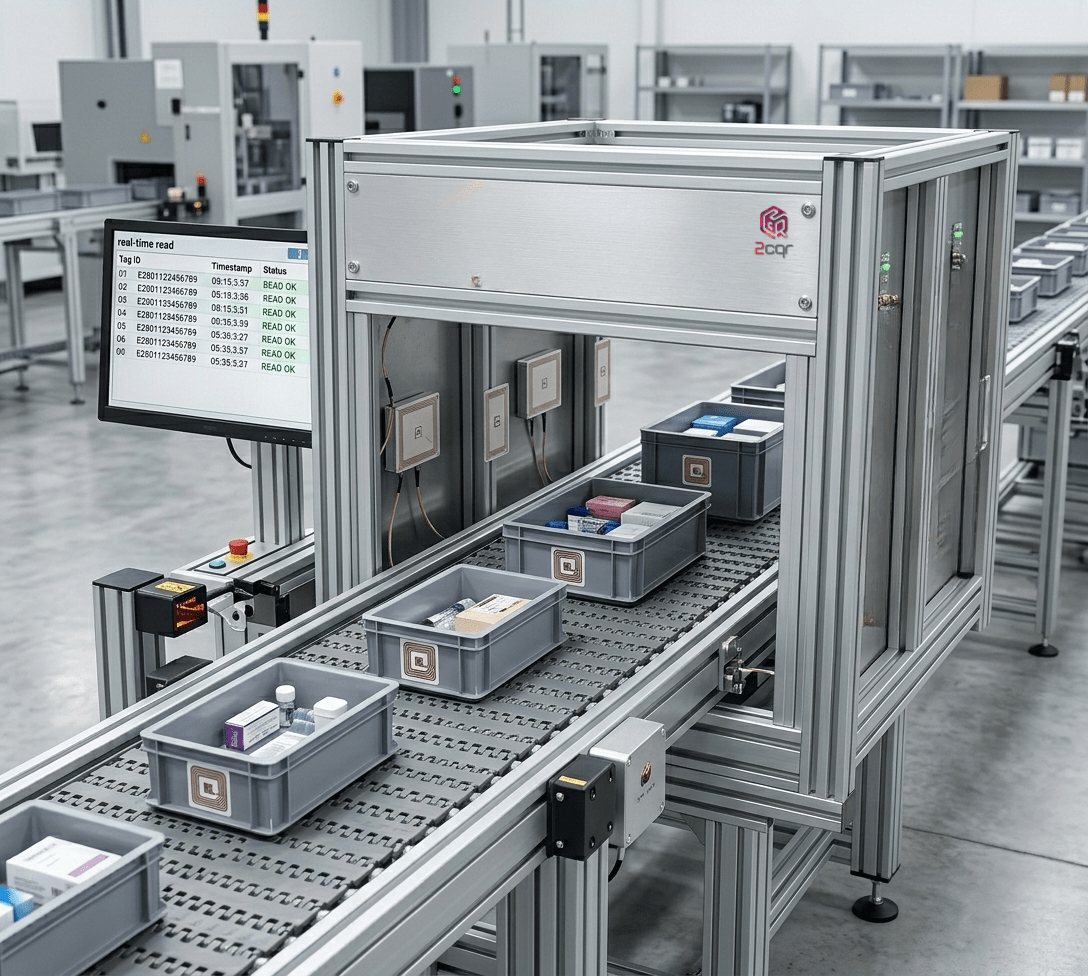
In today’s fast moving world, businesses are constantly looking for ways to save time, reduce manual work, and improve accuracy. One technology that can make a big impact in warehouses, logistics, and retail is the RFID Tunnel.
If you are already using RFID or planning to implement it, understanding RFID tunnels can open up a whole new level of automation.
What is an RFID Tunnel?
An RFID Tunnel is a specially designed enclosed structure fitted with multiple RFID antennas and readers. It is used to automatically scan multiple RFID tagged items at once as they pass through the tunnel.
Instead of scanning items one by one, the tunnel allows bulk reading without human intervention.
In simple words:
It is like a “smart scanning passage” where items are identified instantly as they move through.
How Does an RFID Tunnel Work ?
Step by step process :
- Items are tagged Each product, carton, or asset has an RFID tag attached.
- Items enter the tunnel This can be through:
-
- Conveyor belt
- Manual placement
- Cart or trolley movement
- Multiple antennas scan simultaneously The tunnel has antennas placed strategically:
-
- Top
- Bottom
- Sides
- RFID reader captures data The reader collects tag information instantly.
- Software processes the data The system:
- Identifies items
- Updates inventory
- Flags missing or extra items
- Output / action Based on configuration:
-
- Data gets stored
- Alerts are generated
- Systems get updated in real time
How an RFID Tunnel Looks
-
- RFID antennas
- Reader
- Conveyor system (optional)
Where Can RFID Tunnels Be Used ?
RFID tunnels are highly versatile and are mainly used in industries where large volumes of items need to be tracked quickly and accurately. Below are the most practical and high impact use cases:
1. Warehouses & Logistics :
This is the most common and high value application of RFID tunnels.
In warehouse and logistics environments, there is a constant movement of goods – receiving, storing, picking, packing, and dispatching. Manual checking in such situations is not only slow but also prone to mistakes.
Applications:
- Shipment verification before dispatch
- Inward and outward material tracking
- Carton level or pallet level scanning
- Dispatch validation against orders
- Cross checking items during loading/unloading
Example:
Instead of opening and manually checking 100 boxes, all cartons can be passed through the RFID tunnel. Within seconds, the system will confirm:
Whether all expected items are present
If any item is missing
If any extra/wrong item is included
Practical Benefit:
This ensures zero dispatch errors, faster truck loading, and smooth supply chain operations.
2. Retail & E- commerce :
In retail and e-commerce, speed and accuracy are extremely important, especially during order fulfillment and returns processing.
RFID tunnels help businesses handle bulk product movement without slowing down operations.
Applications:
- Order packing validation (before shipping)
- Returns processing and verification
- Inventory reconciliation in warehouses/stores
- Sorting items based on order requirements
- Batch scanning of apparel, accessories, or FMCG goods
Ensures:
- Right product is packed for the right customer
- No missing or duplicate items in orders
- Faster handling of returns with automatic identification
Example:
During order packing, items can be placed in a box and passed through the tunnel. The system instantly verifies if the order is 100% correct before sealing.
Practical Benefit:
Reduces return rates, improves customer satisfaction, and increases operational speed during peak sales (like festive seasons).
3. Manufacturing Units :
In manufacturing, tracking materials at every stage is important for maintaining production efficiency and quality control.
RFID tunnels help automate tracking of both work-in-progress (WIP) and finished goods.
Applications:
- Tracking items moving between production stages
- Monitoring WIP movement across departments
- Quality check validation before packaging
- Finished goods verification before dispatch
- Batch tracking and traceability
Example:
After production, finished items can pass through the RFID tunnel to verify:
- Correct quantity produced
- Proper tagging
- Matching with production records
Practical Benefit:
Helps in reducing production errors, improving traceability, and ensuring that only verified and correct products move to the next stage.
Why These Industries Benefit the Most
All the above industries have one thing in common:
- High volume of items
- Repetitive scanning processes
- Need for speed and accuracy
RFID tunnels solve these challenges by:
- Automating bulk identification
- Eliminating manual effort
- Providing real time data visibility
Practical Benefits of RFID Tunnel :
Now let’s understand why businesses are adopting RFID tunnels rapidly.
1. Massive Time Saving :
Manual scanning → Slow
Hundreds of items can be read in seconds.
2. High Accuracy :
Human errors are common in manual processes.
RFID tunnel:
Reduces errors
Improves reliability
Ensures correct data capture
3. No Line of Sight Required :
Unlike barcodes, RFID does not need direct visibility.
Items can be:
Inside boxes
Packed together
Randomly oriented
Still, they will be detected.
4. Real Time Inventory Updates :
As items pass through:
Inventory gets updated instantly
No need for manual entry
5. Labour Cost Reduction :
Less dependency on manpower
Reduced repetitive work
Staff can focus on higher value tasks
6. Faster Operations :
Helps in:
Faster dispatch
Faster receiving
Faster auditing
Overall improvement in operational efficiency
7. Scalability :
RFID tunnels can be:
Integrated with conveyor systems
Connected with ERP/WMS software
Scaled based on volume
Challenges and Considerations :
While RFID tunnels are powerful, proper implementation is important.
- Tag Placement
Incorrect placement may reduce readability.
- Material Interference
Metal and liquids can affect signals.
- Calibration Required
System needs tuning for:
- Read accuracy
- Speed
- Environment
- Initial Cost
Higher than barcode systems, but ROI is strong over time.
RFID Tunnel vs Manual Scanning (Quick Understanding) :
Manual: Slow, error prone
Barcode: Faster but still one by one
RFID Tunnel: Bulk, automatic, highly efficient
It is a major upgrade in automation.
Future of RFID Tunnels :
With advancements in AI integration ,IoT connectivity ,Smart analytics
RFID tunnels will become even more intelligent.
Future possibilities:
Predictive inventory management
Automated sorting systems
Fully unmanned warehouses
Conclusion :
An RFID tunnel is not just a scanning device it is a complete automation solution that transforms how items are tracked and managed.
From warehouses to retail stores, its ability to:
Read multiple items instantly
Improve accuracy
Reduce manual work
Makes it a must have technology for modern operations.
If your organization deals with high volume items and repetitive scanning, implementing an RFID tunnel can significantly improve efficiency and reduce operational stress.