


Warehouse management is one of the most critical parts of any business that deals with physical products. Whether it is retail, logistics, manufacturing, or e-commerce, the efficiency of a warehouse directly affects delivery speed, operational cost, and customer satisfaction.
But in reality, managing a warehouse is not always easy. Many businesses struggle with daily operational issues that may seem small individually, but together they create major inefficiencies.
Let us understand the key challenges in warehouse management in a more practical way, along with solutions that businesses can actually implement.
In this blog, we will explore this technology from basics to advanced concepts, including:
- How passive RFID harvests energy
- Solar powered RFID tags
- Energy harvesting architectures
- Benefits for large scale deployments
- Sustainability advantages
- Future developments in battery free RFID systems
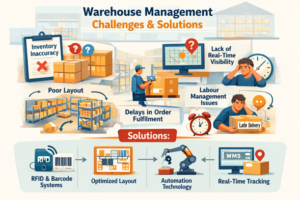
1. Inventory Inaccuracy – A Silent but Costly Problem
One of the most common and frustrating problems in warehouse management is inventory mismatch. What is recorded in the system often does not match what is physically available in the warehouse.
This usually happens because of manual data entry, missed updates, or improper tracking during movement of goods. Over time, even small errors accumulate and lead to serious issues like stockouts, overstocking, or wrong order fulfilment.
Practical solution :
The practical way to solve this is by reducing dependency on manual processes. In a manual system, stock updates usually happen only after someone records them, which can lead to delays and errors.
Technologies like RFID and barcode systems change this completely. Each item is tagged with a barcode label or an RFID tag. Whenever the item is moved whether it is received, stored, picked, or dispatched it is either scanned (in barcode) or automatically detected (in RFID).
This means every movement is recorded instantly in the system without relying on manual entry.
When these systems are integrated with a Warehouse Management System (WMS), the stock levels get updated in real time. So at any moment, the system shows the exact quantity and location of items inside the warehouse.
Regular cycle counting adds another layer of control. Instead of checking the entire inventory at once, small sections are checked periodically. This helps in identifying mismatches early and correcting them before they turn into bigger issues.
Checkout 2cqr’s Warehouse Management products for efficient warehouse management
2. Lack of Real Time Visibility – Working Without Clarity
In many warehouses, managers do not have a clear, real time view of what is happening inside. They may not know the exact stock level, where a particular item is located, or how goods are moving.
This lack of visibility leads to delays, wrong decisions, and inefficiencies in planning.
Practical Solution :
By implementing RFID based tracking along with a Warehouse Management System (WMS), businesses can achieve complete visibility of their operations.
Each item is tagged with an RFID tag, and RFID readers are placed at key points such as entry, storage, and dispatch areas. Whenever goods move through these points, the system automatically detects and records the movement without the need for manual scanning.
This means the exact location, quantity, and status of every item is continuously updated in the system in real time.
As a result, managers no longer have to depend on assumptions or delayed reports. They can see what is happening inside the warehouse at any moment and make quick, informed decisions whether it is managing stock levels, prioritising orders, or planning operations.
3. Delays in Order Fulfilment – Impacting Customer Satisfaction
In today’s fast paced environment, customers expect quick delivery. Any delay in order processing directly affects customer satisfaction and brand reputation.
Delays usually happen due to inefficient picking systems, lack of coordination, or manual processes.
Practical solution :
Streamlining the entire workflow – from picking to packing and final dispatch plays a crucial role in reducing delays in order fulfilment. In many warehouses, delays occur because these processes are not well connected, leading to bottlenecks, confusion, or waiting time between each stage.
By organising the workflow in a structured manner and ensuring smooth coordination between teams, these delays can be minimised. Introducing automation tools such as guided picking systems, automated sorting, and system driven order prioritisation helps in handling orders more efficiently. For example, urgent or high priority orders can be identified and processed faster, while routine orders follow a structured queue.
This reduces manual decision making, speeds up processing, and ensures that orders move continuously without unnecessary interruptions.
Faster fulfilment not only improves customer satisfaction through timely deliveries but also strengthens internal operations. It reduces backlog, improves resource utilisation, and allows the warehouse to handle higher volumes without increasing pressure on the workforce.
4. Labour Management Issues – Balancing Efficiency and Accuracy
Warehouse operations depend heavily on human effort. However, without proper training and systems, this can lead to errors in picking, packing, and handling.
Sometimes workers are overburdened, while at other times resources are not used efficiently. This imbalance affects both productivity and accuracy.
Practical Solution :
Providing proper training and clearly defined Standard Operating Procedures (SOPs) plays a key role in reducing errors in daily operations. When employees understand the correct process for picking, packing, and handling goods, the chances of mistakes reduce significantly.
At the same time, introducing automation in critical areas helps minimise dependency on manual work. For example, using scanning systems, automated tracking, or guided workflows ensures that tasks are performed in a structured and consistent manner.
This combination of trained manpower and supportive technology creates a more efficient working environment. Employees are able to complete tasks faster, with better accuracy, and with less confusion or rework.
Instead of increasing workload, technology acts as a support system helping the workforce perform better while maintaining consistency and quality in operations.
5. Security and Theft Issues – A Growing Concern
Security is another major concern in warehouse management. Theft, unauthorised access, and lack of monitoring in certain areas can lead to inventory loss.
In many cases, areas between racks are not properly monitored, creating blind spots.
Practical Solution:
Installing CCTV systems and access control solutions plays an important role in strengthening warehouse security. These systems not only help in monitoring activities but also ensure that only authorised personnel can access sensitive areas.
More importantly, the visibility of monitoring itself creates a sense of accountability. When employees are aware that the area is under active surveillance, they tend to be more cautious and responsible in their actions.
This awareness acts as a strong preventive measure, naturally reducing the chances of theft, unauthorised access, and other unwanted behaviour, while promoting a more disciplined and secure working environment.
Installing CCTV systems and access control solutions helps in improving security. More importantly, visible monitoring plays a key role in creating discipline.
When people are aware that the area is under surveillance, it naturally reduces unwanted behaviour.
Conclusion :
Warehouse management challenges are common, but they are not impossible to solve. The key lies in identifying the gaps and taking practical steps to improve them.
Moving towards a more organised, technology driven approach can make a huge difference. Even small improvements in tracking, layout, or monitoring can lead to better efficiency and accuracy over time.
In today’s competitive environment, businesses that optimise their warehouse operations will always have an advantage.