

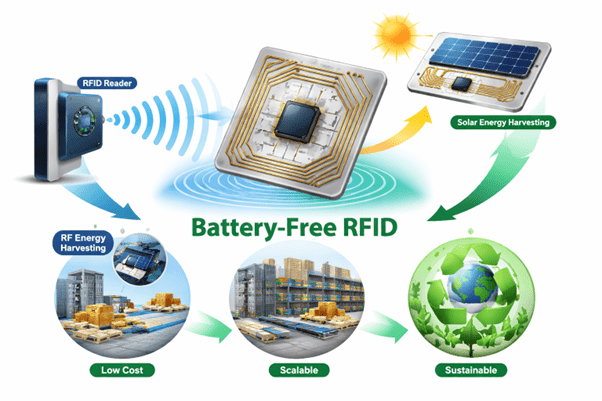
RFID technology is already playing an important role in industries like logistics, retail, manufacturing, and libraries by enabling automatic identification and tracking of assets. In recent years, one of the most exciting developments in this field is battery free RFID and energy harvesting RFID technology.
Instead of relying on a battery, these RFID tags capture energy from external sources such as radio waves, light, motion, or heat to power their operations. This concept is known as energy harvesting, where devices collect energy from their surrounding environment to operate autonomously. This innovation is especially important for largescale deployments where replacing or maintaining batteries would be expensive and impractical.
In this blog, we will explore this technology from basics to advanced concepts, including:
- How passive RFID harvests energy
- Solar powered RFID tags
- Energy harvesting architectures
- Benefits for large scale deployments
- Sustainability advantages
- Future developments in battery free RFID systems
Unerstanding RFID Basics :
Before exploring battery free RFID, it is important to understand how RFID technology works.
RFID stands for Radio Frequency Identification. It is a wireless technology that uses radio waves to identify and track objects automatically.
A typical RFID system consists of three main components:
A small electronic device attached to an object that stores data such as an ID number or product information.
A device that sends radio signals and receives data from RFID tags.
- Antenna
An antenna enables communication between the tag and the reader by transmitting and receiving radio waves.
When a tagged object enters the reader’s electromagnetic field, the tag sends its stored data back to the reader. The reader then sends this information to a computer system or database.
Types of RFID Tags Based on Power Source :
RFID tags are usually classified based on how they obtain power.
Passive RFID Tags :
Passive RFID tags do not have a battery. Instead, they obtain energy from the RFID reader’s radio signal to power their microchip and transmit data.
These tags are:
- Small and lightweight
- Low cost
- Longlasting
- Widely used in logistics and retail
Active RFID Tags :
Active RFID tags contain an internal battery. This allows them to transmit signals continuously and operate over longer distances.
However, batteries increase:
- Cost
- Size
- Maintenance requirements
Semi Passive (Battery-Assisted) RFID :
These tags contain a battery to power the chip but still rely on the reader for communication.
The Concept of Battery Free RFID :
Battery free RFID refers to systems where the tag operates without a dedicated power source. Instead, it harvests energy from the surrounding environment.
Energy can be harvested from:
- Radio frequency signals
- Solar energy
- Motion or vibration
- Heat differences
- Magnetic fields
The collected energy is converted into electrical power that runs the RFID chip and allows it to transmit data.
This technology is becoming extremely important in the Internet of Things (IoT) ecosystem, where billions of small devices must operate autonomously for long periods.
How Passive RFID Harvests Energy :
The most common example of battery free RFID is the passive RFID tag.
Passive tags operate using a process known as RF energy harvesting.
Step 1: Reader Emits RF Signal
The RFID reader sends out a radio frequency signal, creating an electromagnetic field.
Step 2: Tag Antenna Captures Energy
When a passive tag enters this field, its antenna captures the RF energy.
Step 3: Rectifier Converts RF Energy
The tag contains a circuit that converts the captured RF signal into direct current (DC) electricity.
Step 4: Microchip Gets Powered
This electricity powers the tag’s microchip.
Step 5: Backscatter Communication
The tag sends data back to the reader by reflecting the RF signal using a technique called backscatter communication.
This entire process happens in milliseconds.
Role of Rectennas in Energy Harvesting :
A key component enabling RF energy harvesting is the rectenna.
A rectenna is a combination of:
- Antenna
- Rectifier circuit
The antenna captures radio waves, and the rectifier converts them into usable electrical energy. Rectennas are widely used in RFID tags and contactless smart cards.
Without rectennas, battery free RFID systems would not be possible.
Solar Powered RFID Tags :
Another important development in battery free RFID technology is solar powered RFID tags.
These tags use photovoltaic cells to convert sunlight or indoor lighting into electrical energy.
How Solar RFID Tags Work
- Solar cells capture light energy
- The energy is converted into electrical power
- Power is stored temporarily in capacitors
- The RFID chip operates using the stored energy
In advanced designs, solar energy can significantly increase the read range and sensing capability of RFID devices.
Some experimental systems combine solar power with RF harvesting, creating hybrid systems that operate even in low light conditions.
Hybrid Energy Harvesting RFID Systems :
Researchers are also developing hybrid RFID energy harvesting systems.
These systems combine multiple energy sources such as:
- RF energy
- Solar energy
- Ambient electromagnetic energy
For example, a hybrid RFID system may include:
- Solar panel
- RF harvesting antenna
- Rectifier circuit
- Energy storage capacitor
- RFID integrated circuit
Such systems can achieve high power conversion efficiency and enable more complex sensing and computing functions.
Energy Harvesting for RFID Sensors :
Battery-free RFID technology is now being extended beyond identification.
Modern RFID tags can include sensors that measure:
- Temperature
- Humidity
- Vibration
- Pressure
- Structural stress
Some experimental RFID sensor tags harvest energy from magnetic fields or ambient RF signals to power sensing operations.
These systems can monitor equipment health in industrial environments without needing battery replacement.
Applications of Battery Free RFID Technology :
Energy harvesting RFID tags are increasingly used in many industries.
Supply Chain and Logistics
Battery free RFID is widely used to track:
- Pallets
- Packages
- Shipping containers
- Warehouse inventory
Because passive RFID tags are inexpensive and longlasting, they are ideal for large-scale supply chain operations.
Smart Warehouses
RFID energy harvesting systems enable:
- Automated inventory tracking
- Smart shelves
- Conveyor belt tracking
- Dock door monitoring
Retail Industry
Retail companies use passive RFID tags for:
- Inventory management
- Anti- heft tracking
- Smart fitting rooms
Healthcare
RFID tags help track:
- Medical equipment
- Pharmaceutical products
- Laboratory samples
Smart Libraries
Libraries use RFID tags for:
- Self checkout systems
- Automated return sorting
- Inventory management
Industrial Monitoring
Energy harvesting RFID sensors are used in:
- Factory equipment monitoring
- Structural health monitoring
- Smart infrastructure systems
Benefits for Large Scale Deployments :
Battery free RFID technology provides several advantages when deployed at large scale.
- Low Cost
Passive RFID tags are very inexpensive and can cost only a few rupees per tag.
This makes them suitable for tagging millions of products.
- Minimal Maintenance
Since there are no batteries, there is no need for battery replacement.
This reduces maintenance costs significantly.
- Long Operational Life
Battery free RFID tags can operate for many years without failure.
- Lightweight and Compact
Without batteries, tags can be made extremely thin and flexible.
- Easy Integration
RFID tags can be embedded into:
- Packaging
- Labels
- ID cards
- Industrial equipment
- Scalability
Large warehouses and supply chains can deploy millions of RFID tags without worrying about battery maintenance.
Sustainability Advantages :
One of the biggest advantages of battery-free RFID technology is sustainability.
Reduced Electronic Waste
Batteries contribute significantly to electronic waste. Battery free RFID systems eliminate this issue.
Lower Environmental Impact
Passive RFID tags use very small amounts of materials and energy.
Energy Efficient Operation
Energy harvesting enables devices to operate using ambient energy sources, reducing overall energy consumption.
Support for Circular Economy
RFID enables better product tracking, which helps in:
- Recycling management
- Reverse logistics
- Waste reduction
Sustainable IoT Infrastructure
Battery free devices are essential for building large scale green IoT ecosystems.
Challenges in Energy Harvesting RFID :
Despite its advantages, energy harvesting RFID still faces some challenges.
Limited Power Availability
Energy harvested from RF signals is very small.
This limits the processing capabilities of RFID tags.
Shorter Read Range
Passive tags typically have shorter communication ranges compared to active tags.
Environmental Dependency
Solar harvesting depends on light availability.
Circuit Efficiency
Energy conversion circuits must be extremely efficient to operate with small power levels.
However, ongoing research is continuously improving these technologies.
Future Trends in Battery Free RFID :
Battery-free RFID is evolving rapidly.
Some important future trends include:
Printed and Flexible RFID Electronics
New materials such as graphene and printed electronics are making RFID tags cheaper and thinner.
RFID Based IoT Sensors
Battery free RFID sensors will enable smart cities and industrial monitoring systems.
Long Range Backscatter Communication
Advanced backscatter architectures may extend RFID communication distances significantly.
Smart Packaging
RFID tags embedded into packaging will enable real time product tracking.
AI Driven RFID Systems
Combining RFID data with AI analytics will enable predictive supply chain management.
Conclusion :
Battery free RFID and energy harvesting technologies are transforming the way we deploy connected devices. By capturing energy from radio waves, sunlight, and other ambient sources, RFID tags can operate without batteries, enabling low cost, maintenance free, and scalable tracking systems.
From supply chain management and smart warehouses to IoT sensing and sustainable infrastructure, battery free RFID systems are becoming a key technology for the future.
As research continues to improve energy harvesting efficiency and sensing capabilities, we can expect RFID to play an even greater role in building smart, connected, and sustainable digital ecosystems.