

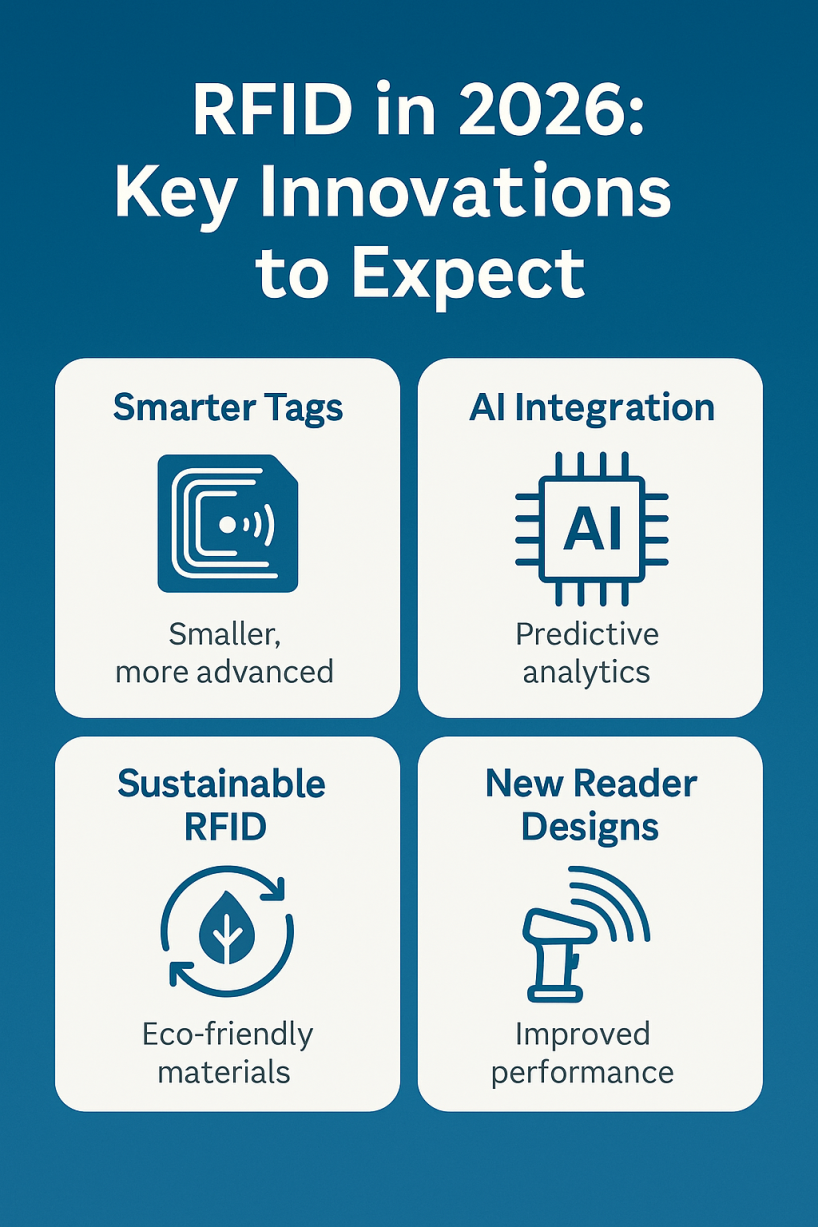
RFID has quietly moved from being a basic identification tool to becoming the backbone of modern automation. Whether it is a library issuing thousands of books each day, a retail store managing fast moving inventory, or a warehouse tracking goods across continents, RFID is now shaping real time decision making. As we step into 2026, the technology is entering a new phase which is more intelligent, more effective, and more deeply integrated with digital ecosystems.
This blog explores the most important innovations we can expect in RFID by 2026 and how these changes will modernize operations across sectors.
RFID in 2026, RFID future trends, future of RFID, RFID technology innovations, RFID trends 2026, next generation RFID, AI and RFID integration, smart RFID tags, RFID readers, RFID automation, RFID access control, RFID security gates, RFID inventory management, RFID for libraries, RFID for retail, sustainable RFID technology, AI based RFID systems, RFID enabled smart gates, RFID digital transformation, real time RFID tracking
One of the biggest shifts in 2026 will come from next generation RFID tag designs. With rapid progress in flexible electronics, printed antennas, and low power ICs, tags are becoming thinner and more adaptable to different surfaces.
Key improvements expected in 2026 :
Printed and flexible antennas that reduce manufacturing cost and allow tags to bend around curved objects like bottles, tools, and small retail items.
Eco friendly tag substrates made from paper, biodegradable materials, or recycled fibers.
Better memory and security features inside the chip to prevent cloning and unauthorized access.
Ultra low cost UHF tags enabling mass tagging even in industries that avoided RFID due to price concerns.
These upgrades will make RFID tags more accessible across libraries, garment retail, logistics, healthcare, and even government applications.
Until now, RFID systems mostly told us “what is where.”
In 2026, they will start telling us “what will happen next.”
The integration of AI and machine learning with RFID readers and middleware will allow businesses to:
- Predict stockouts before they happen
- Identify unusual movement of items
- Provide automated alerts for shrinkage or loss
- Optimise staff workload by analysing traffic patterns
- Improve check in and checkout workflows
Readers will increasingly come with built in edge analytics, reducing the need for big servers. This means many insights will be generated instantly, right at the point of scanning.
RFID readers are evolving faster than ever. In 2026, we will see:
Improved read sensitivity, allowing better detection of densely packed tags
Wider read zones in retail stores and warehouses
Reduced interference in environments filled with metal shelves or liquids
Hybrid readers that combine RFID + BLE or RFID + Wi-Fi for multi technology tracking
Smaller, battery efficient handheld readers that can scan thousands of items within minutes
Access controlled spaces (libraries, offices, campuses) will use RFID smart gates connected to intelligent software that can automatically detect unusual or unauthorised movement, improving security without slowing down regular users.
Digital twins virtual replicas of physical spaces are becoming popular in industry, and RFID will act as the foundational data layer.
By 2026, many modern warehouses, retail chains, and large libraries will use RFID data to:
- Simulate stock movement
- Plan shelf layouts
- Improve space utilisation
- Identify bottlenecks in workflows
- Test operational changes digitally before implementing them
This reduces risk, improves long term planning.
2026 will see a serious push toward green RFID. With growing global attention on environmental impact, manufacturers are shifting to:
- Paper-based antennas instead of aluminum
- Biodegradable tag materials
- Ink based conductive printing that reduces industrial waste
- Energy harvesting tags powered by solar or ambient RF signals
Solar powered RFID tags, in particular, are expected to gain attention for outdoor tracking, agriculture, and large scale logistics.
2026 will be a tipping point where many industries adopt RFID not as a luxury, but as a necessity. Reasons for this shift include:
Barcodes require manual scanning; RFID does not
RFID improves accuracy to near 99%
Audits and stock taking become dramatically faster
Real-time visibility reduces losses and human error
RFID integrates easily with ERP, LMS, and analytics software
We will see strong adoption in:
- Retail and fashion
- Libraries and educational institutions
- Hospitals
- Manufacturing
- Government offices
- Airports and public transport
- Pharma cold chain
- Event and crowd management
In 2026, RFID systems will focus heavily on improving user experience.
Libraries will offer faster checkouts, zero queue book returns, and smart shelves that help users instantly locate books.
Retail stores will move toward walk in, walk out shopping models, where items are automatically billed as customers leave the store.
Access control will feel more natural and automated, with contactless entry, smart barriers, and AI assisted monitoring.
The goal is simple:
make RFID invisible to the user, but powerful in the background.
Conclusion :
2026 is shaping up to be a breakthrough year for RFID. With smarter tags, intelligent readers, AI driven analytics, eco friendly designs, and deeper industry adoption, RFID will no longer be just a tracking tool. It will become an essential component of automation, decision making, and real time visibility across multiple sectors.
For businesses, libraries, and institutions, the question is no longer “Should we adopt RFID?”
It is “How quickly can we adopt it to stay competitive?”