


Effective billing and inventory management are essential for modern retailers to provide exceptional customer experiences. The RFID Billing Station has emerged as a game-changer, especially for sectors like jewellery and retail, where accurate and quick transactions are critical. In this blog, we will explore what RFID billing stations are, how they work, their features, and the benefits they offer to retailers and customers..
What is an RFID Billing Station?
An RFID Billing Station is a smart billing solution that utilizes Radio Frequency Identification (RFID) technology to simplify the checkout process. Unlike conventional barcode systems, where each item must be scanned individually, RFID technology allows the billing station to read multiple RFID tags simultaneously. This feature speeds up the billing process and ensures greater accuracy, eliminating human errors often associated with manual barcode scanning .
For example, in a retail store selling clothes and accessories, an RFID billing station can scan all the tagged items in a customer’s shopping basket in one go. There is no need to scan each item manually. The station quickly identifies all products, processes the sale through an integrated Point of Sale (POS) system, and calculates the total cost instantly. Additionally, the system updates the store's inventory in real time, ensuring that the stock levels accurately reflect the items sold.
This feature speeds up the billing process, making shopping more convenient for customers by reducing long queues at checkout counters. For retailers, it simplifies billing, keeps inventory records accurate, and smoothly connects sales with stock management systems.
How Does an RFID Billing Station Work?
-
RFID Tag Scanning :
The staff places all the tagged items on or near the RFID reader at the billing station. The RFID reader scans the embedded tags instantly, identifying each item without the need for manual scanning or line-of-sight.
-
Displaying Scanned Items and Total Cost :
Once the tags are scanned, the system displays the details of each item—such as product name, price, and quantity—on a screen. The total cost of all scanned items is calculated and shown, making it easy for both the staff and customers to verify the purchase.
-
Data Processing :
The system automatically captures and processes detailed information from the RFID tags, including the product type, price, and a unique identification code. This ensures that no item is missed or miscalculated during billing.
-
POS Integration :
The billing station integrates with a Point of Sale (POS) system to finalize the transaction. It handles calculations, applies taxes or discounts, and accepts various payment methods, such as cards, mobile wallets, or gift cards, ensuring a smooth checkout process.
-
Item Collection :
Once the billing is complete, the staff or the customer can collect all the scanned items.
-
Real-Time Updates :
After the transaction, the inventory management system automatically updates stock levels in real time. This ensures that the store's database reflects the current availability of each product, making it easier to track items and plan restocking.
-
Customer Engagement :
The system can also save customer data, such as purchase history, preferences, and contact information. This information can be used for personalized services like sending offers, loyalty rewards, or tailored product recommendations, for a better shopping experience.
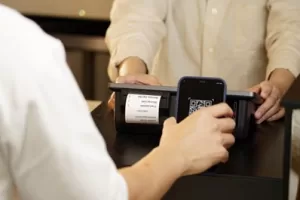
Key Features of RFID Billing Stations
-
Advanced RFID Reader :
Can scan multiple items simultaneously and with high accuracy, reducing checkout times.
-
Dual Display System :
A secondary display allows customers to view all transaction details in real-time, for transparency.
-
High-Speed Receipt Printer :
Prints receipts quickly with customizable options, such as QR codes or loyalty program details
-
Contactless Payment Options :
Supports modern payment methods, including UPI, Credit & debit cards, and digital cards.
-
Integration with ERP / CRM :
Easily connects to ERP, CRM, inventory management, and e-commerce platforms for synchronized operation.
-
Portable Billing Solutions :
Mobile RFID billing stations allow businesses to offer self-checkout or flexible payment counters during peak hours or promotional events.
Comparison: RFID Billing Stations vs. Traditional Billing Systems
| Feature | RFID Billing Station | Normal Billing Station |
|---|---|---|
| Scanning Method | Uses RFID tags for wireless and automatic item identification. | ERequires manual barcode scanning, often one item at a time. |
| Speed | Scans multiple items simultaneously, reducing checkout time. | Scans items individually, making the process slower. |
| Accuracy | Highly accurate, as there’s no reliance on line-of-sight or manual input. | Prone to human error, such as missed or incorrectly scanned items. |
| Speed | Scans multiple items simultaneously, reducing checkout time. | Scans items individually, making the process slower. |
| Payment Integration | Supports modern payment methods like UPI, digital wallets etc | May support basic card payments,and UPI . |
| Inventory Update | Updates stock levels in real-time after each transaction. | Requires manual stock updates or synchronization post-billing. |
| Customer Experience | Transparent, quick, and personalized checkout with engagement options like loyalty programs. | Slower and less engaging experience. Limited personalization. |
| Hardware | RFID reader, dual displays, and integrated POS systems. | Barcode scanner, basic display, and standalone POS systems. |
| Flexibility | Portable and scalable, suitable for self-checkout or mobile billing. | Typically fixed at counters, less flexibility. |
| Operational Cost | Reduces labour dependency with automated scanning. | Relies on manual effort, increasing labour costs. |
| Error Detection | Automatically detects duplicate or misplaced items during scanning. | Errors often go unnoticed until manual cross-checking. |
| Customer Data Collection | Saves detailed purchase history for loyalty rewards and tailored offers. | Limited data capture, often only basic purchase details. |
Applications of RFID Billing Stations
- Retail Stores: Ideal for fashion, electronics, and supermarkets to manage billing and inventory.
- Jewellery Stores: Rapidly scans and processes high-value items with precision.
- Self-Checkout Counters: Enables customers to scan and pay for items without staff assistance.
- Pop-Up Shops: Mobile billing stations are perfect for temporary or remote retail setups.
Why Choose 2CQR RFID Billing Stations?
At 2CQR, we bring over 10 years of experience in delivering advanced RFID solutions across various sectors like retail, jewellery, manufacturing, textiles, and more.
-
Customizable Designs :
We offer solutions designed to fit your business needs, with scalable options and add-ons as you grow.
-
Integration Flexibility :
Our RFID Billing system connects with a wide range of ERP, CRM, and e-commerce platforms for synchronized operations.
-
Data Insights :
Generate detailed reports on sales trends, customer behaviour, and inventory levels to support informed decision-making.
-
Solid Customer Support :
We provide exceptional assistance post-installation, ensuring your systems run smoothly with ongoing maintenance and troubleshooting.
-
Scalable Solutions :
Designed to evolve with your business, our systems grow with your expanding needs.
Kindly check out 2CQR's RFID billing stations, designed for retail stores, jewellery shops, and more, to automate your billing process.