

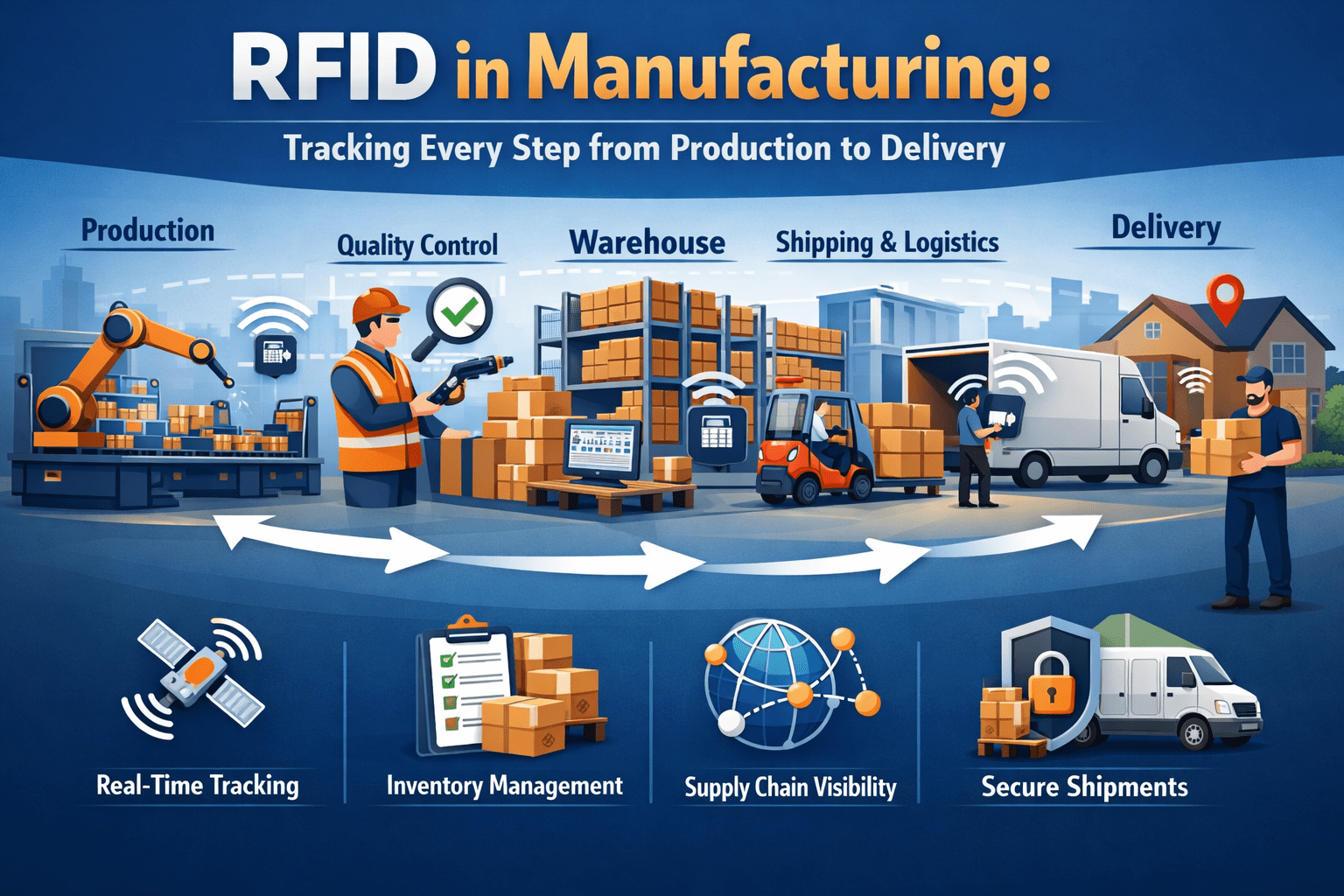
Manufacturing industries today are under constant pressure to improve efficiency, reduce errors, and maintain complete visibility across their operations. From raw material procurement to final product delivery, every stage needs to be monitored accurately. This is where RFID (Radio Frequency Identification) plays a very important role.
RFID helps manufacturers track, trace, and manage materials, components, and finished goods in real time, ensuring better control and decision making across the entire manufacturing lifecycle.
What Is RFID in Manufacturing?
In manufacturing, RFID uses RFID tags, readers, and antennas to automatically identify and track materials and products without manual intervention. RFID tags are attached to raw materials, work in progress items, pallets, containers, or finished products, allowing each item to carry its own digital identity.
RFID readers installed at key locations such as entry points, production lines, warehouses, and dispatch areas capture tag data automatically as items move through the factory. This data is then transmitted to backend software systems like ERP, MES, or inventory management systems, providing real time visibility across operations.
Unlike barcodes, RFID does not require direct line of sight, which means tags can be read even if they are inside boxes or pallets. RFID can also read multiple items simultaneously, making it highly suitable for fast paced, high-volume manufacturing environments where speed, accuracy, and automation are critical.
RFID at the Raw Material Stage
-
RFID Tagging of Raw Materials :
At the entry point, RFID tags are attached to raw materials, containers, or pallets, giving each item a unique digital identity.
-
Automated Goods Receipt :
Once tagged, RFID readers automatically detect the materials as they enter the factory, recording their arrival without manual checking or paperwork.
-
Real Time Inventory Visibility :
Material quantity and storage location are updated instantly in the system, providing accurate and up to date inventory information.
-
Faster Inward Processing :
Since data capture is automatic, goods inward operations become faster and errors caused by manual counting are eliminated.
By tagging raw materials at the start, manufacturers can avoid shortages, prevent overstocking, and maintain accurate inventory records throughout the production cycle.
RFID in Production and Work in Progress (WIP)
-
Continuous Production Tracking :
As tagged components move across different production lines and workstations, RFID readers fixed at key points automatically capture their movement in real time.
-
Process Flow Monitoring :
Each production stage is recorded in the system, allowing supervisors to identify bottlenecks, delays, or idle time without manual reporting.
-
Right Component at the Right Station :
Each component carries an RFID tag linked to its process route in the system. When the component reaches a workstation, the RFID reader verifies whether it belongs to that station. If the wrong component arrives, the system can alert the operator or block the process, thereby preventing mix-ups and assembly errors.
This real time visibility across WIP helps manufacturers improve production efficiency, maintain consistent output quality, and reduce rework and downtime.
RFID for Quality Control and Traceability
-
Batch Level Product Identification :
Each product carries an RFID tag that is linked in the system to its batch number, production date, machine used, operator details, and process parameters, creating a complete production record.
-
Issue Detection and Root Cause Analysis :
If a defect is identified, RFID data allows manufacturers to trace the product back through every production stage to pinpoint the exact machine, process step, or batch where the issue occurred.
-
Fast and Controlled Product Recall :
During recalls, RFID helps quickly identify only the affected batches or products, enabling manufacturers to isolate them without disturbing unaffected stock.
This end to end traceability helps manufacturers meet quality standards, comply with regulatory requirements, reduce recall impact, and build strong customer confidence.
RFID in Finished Goods Management
-
RFID Tagging of Finished Products :
RFID Tagging of Finished Products: After production is completed, finished goods are tagged or continue to use existing RFID tags, allowing each product or carton to be uniquely identified in the warehouse.
-
Accurate Finished Goods Inventory :
RFID readers automatically update stock levels as finished goods move into storage areas, providing real time inventory visibility without manual stock verification.
-
Error Free Picking and Packing :
During order fulfilment, RFID validates each item against the order details. If an incorrect product is picked, the system can alert the operator before packing, reducing dispatch and shipment errors.
-
Faster Product Location and Storage :
RFID helps locate finished goods quickly within the warehouse, improving space utilisation and reducing time spent searching for products.
With RFID based finished goods management, manufacturers achieve faster order processing, higher accuracy, and improved control over warehouse operations.
RFID in Logistics and Delivery
-
RFID Based Shipment Identification :
Before dispatch, RFID tags attached to cartons, pallets, or containers are linked to shipment details such as order number, destination, transporter, and dispatch date, allowing each shipment to be uniquely identified and tracked throughout the delivery process.
-
Real Time Movement Tracking :
As goods move through dispatch gates, warehouses, and transit checkpoints, RFID readers automatically capture movement updates without manual scanning.
-
Accurate Dispatch and Delivery Confirmation :
Shipment status is updated in real time, enabling confirmation of dispatch and delivery while reducing manual errors and disputes.
-
Reduced Loss and Theft During Transit :
Continuous tracking of RFID tagged shipments helps detect missing or unauthorised movement early, minimising loss and theft.
With RFID in logistics, manufacturers gain end-to-end visibility from factory to delivery point, improving reliability and customer satisfaction.
Integration with ERP and Manufacturing Systems
-
Centralised Real Time Data Visibility :
RFID systems integrate with ERP, MES (Manufacturing Execution System ), and warehouse management software to provide a single, real time view of production, inventory, and logistics data.
-
Automated Data Capture and Reporting :
Since data is captured automatically, reports on production status, stock levels, and shipments are generated without manual data entry.
-
Improved Planning and Forecasting :
Accurate and up to date RFID data helps manufacturers plan production schedules, manage demand, and optimise resource utilisation.
System integration ensures that RFID data is not just collected, but converted into meaningful insights for better decision making.
Conclusion :
For manufacturers focused on improving operational efficiency, maintaining quality standards, and meeting delivery commitments, RFID serves as a practical and reliable foundation rather than just a technology upgrade. Implementing RFID supports informed decision making and prepares manufacturing operations for long term scalability and growth.