


When people think of RFID in jewellery, the first things that usually come to mind are security and inventory management on the shop floor. And yes, that’s important. But what often goes unnoticed is how RFID helps the behind-the-scenes the place where real business happens: the back-end operations.
If you're a jeweller or work closely with store management, you already know that what's behind the counter is just as critical as what's on display. From goods inward to inter-branch transfers, and repair tracking to audits, RFID is quietly changing the game for the better.
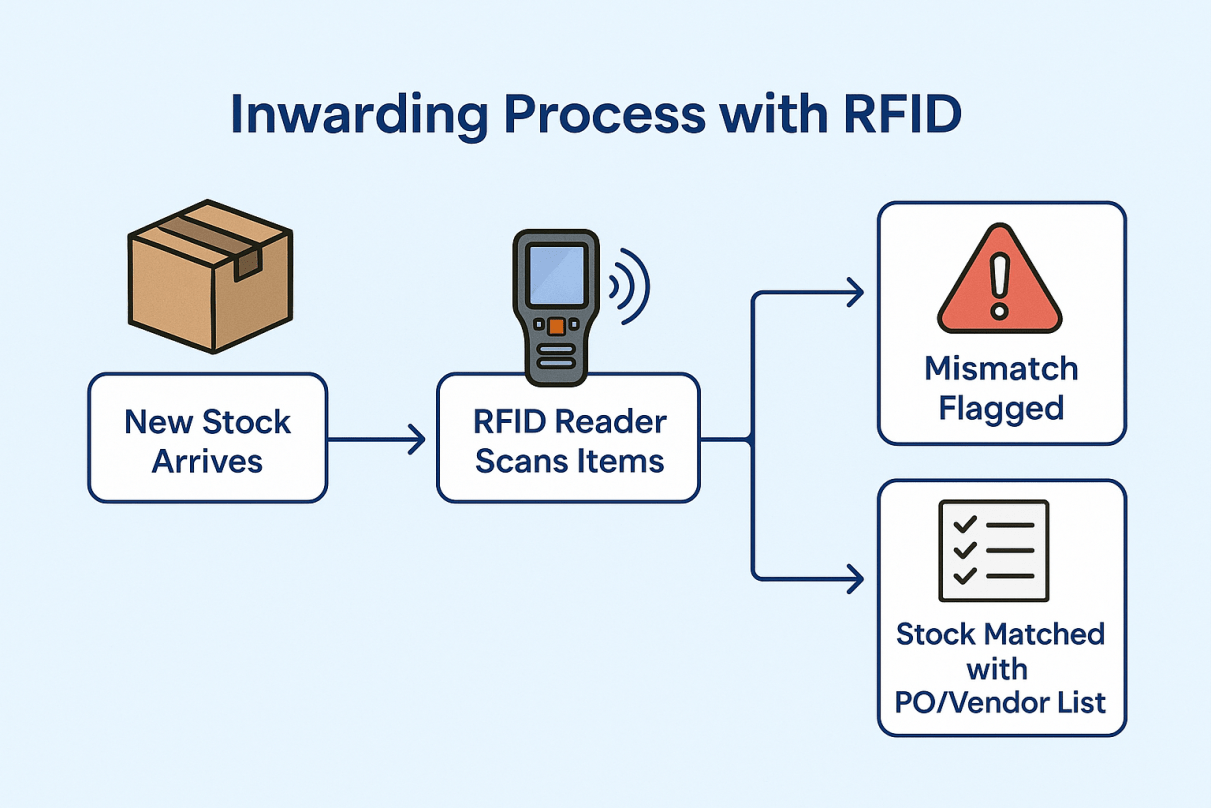
1. Receiving New Stock: RFID Makes Inwarding Accurate and Easy :
Traditionally, when a new consignment arrives, staff manually cross-check every item with the invoice or stock list. This is time-consuming, error-prone, and exhausting—especially when hundreds of small items like studs, rings, and chains are involved.
- Each item arrives with a pre-attached RFID tag.
- An RFID reader scans the items within seconds—no need to unpack everything.
- The system auto-matches the items with the PO or vendor list.
- Mismatches, shortages, or excess stock are flagged immediately.
2. Inter-Branch Transfers of Jewellery :
Whether you're transferring stock from your head office to a branch or from one showroom to another, there’s always a risk—items getting misplaced, delayed, or not recorded properly.
- Each item is scanned during packing and logged into a transfer note digitally.
- When it reaches the destination branch, RFID instantly verifies if all items arrived as per the dispatch list.
- Partial deliveries and damage can be tracked accurately with timestamps.
3. Repair and Customization Tracking: Keep It Transparent :
Jewellery repair or customisation is delicate and emotionally significant for the customer. Losing track of these items can lead to loss of trust—or worse, legal issues.
- The jewel is tagged and assigned a unique repair job ID.
- Every movement—from receiving at the counter, transfer to workshop, repair completion, to delivery—is logged via RFID scans.
- Staff can instantly check the status and history of the item.
4. Periodic Stock Audits :
Periodic audits are dreaded by most jewellery businesses. It means hours—or days—of closing the store, counting every piece manually, and still ending up with mismatches.
- Audits can be done without removing items from trays or lockers.
- Handheld RFID scanners or fixed readers can count hundreds of items in minutes.
- The system highlights only the mismatched or missing items for manual checking.
5. Real-Time Stock Visibility Across Locations :
One of the most overlooked back-end challenges is lack of central visibility especially in chains with multiple stores. Staff don’t know where a particular design is available unless they call around.
- Each item’s last known location is updated in real-time.
- A centralized dashboard shows stock across branches, in transit, under repair, or in safe storage.
- Sales staff can instantly find and reserve a product for a customer—even if it’s in another city.
6. Back-End Security with RFID-Enabled Storage :
Not all theft happens from the display. Internal theft from storage rooms, safes, or even during transfer can be just as risky.
- RFID-tagged storage trays, pouches, or cabinets automatically log when items are removed or placed.
- Access logs can be linked with staff IDs and timestamps.
- Alerts can be triggered for unauthorized access or movement during non-operational hours.
RFID as an Operational Backbone :
Jewellery stores that invest in RFID usually start with the sales floor in mind. But the real power of RFID lies behind the scenes. It eliminates friction, saves time, reduces human error, and builds a data-driven culture.
Whether you're running a single-store operation or managing 50 branches, integrating RFID into your back-end workflows will bring a sense of control, clarity, and calm to your business.